


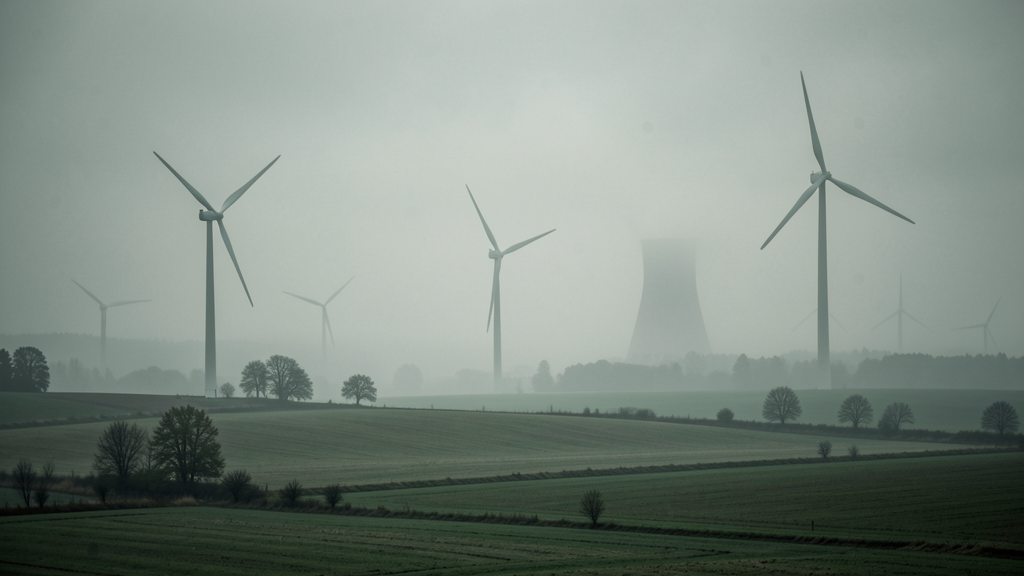
Germany Shut Down Its Last Three Nuclear Plants on April 15, 2023
The event was celebrated as a triumph. The Bild newspaper ran a front page showing a nuclear cooling tower with a smiley face and the caption “Bye-bye, atom.” The government declared that Germany was now leading the world into a clean energy future.
What no one said at the celebration was that Germany had just shut down three of the safest, most reliable, zero-carbon power plants in Europe - and replaced their output with Russian natural gas, Polish coal, and French nuclear electricity imported over the grid.
This is the German Energiewende in miniature. A policy that promised cheaper, cleaner, more reliable energy delivered the opposite on every measure. It is the most expensive energy policy experiment in modern history, and its lessons apply to every country considering a similar path.
What Was Promised
The Energiewende (“energy transition”) was formally adopted in 2010, though its roots go back to the Renewable Energy Sources Act (EEG) of 2000. The core promises were:
1. Germany would phase out nuclear power by 2022. After Fukushima in 2011, this was accelerated - eight reactors were shut down immediately.
2. Germany would replace nuclear and fossil fuels with renewable energy. Wind and solar would scale up to fill the gap. The grid would remain reliable.
3. German electricity prices would remain stable or decline. The cost of renewables would fall as the technology matured, and those savings would be passed to consumers.
4. German carbon emissions would drop dramatically. The country that invented climate policy would show the world how it was done.
None of these promises were kept.
What Actually Happened
Nuclear was replaced by coal and gas, not renewables.
The eight reactors shut down after Fukushima were replaced primarily by coal-fired generation. In 2011, the year of the acceleration, German coal imports hit a record high. Lignite (brown coal) - the dirtiest form of coal - actually increased as a share of German electricity generation for several years after the nuclear phase-out began.
By 2023, when the final three reactors were shut down, Germany was importing more electricity from France (which gets 70 percent of its power from nuclear) and Poland (which gets 80 percent from coal) than it exported. The country had effectively outsourced its carbon emissions while congratulating itself for reducing them.
Emissions did not drop meaningfully.
German carbon emissions in 2023 were roughly where they were in 2010. The modest declines that did occur were mostly driven by the collapse of East German industry in the 1990s and the 2008 financial crisis, not by renewable energy policy.
A 2021 study by the German Institute for Economic Research (DIW) found that the Energiewende had reduced German CO₂ emissions by approximately 85 million tonnes per year - at a cost of roughly €500 billion in subsidies through 2020. That works out to about €5,882 per tonne of CO₂ abated. For comparison, the European Union’s Emissions Trading System was pricing carbon at about €50 per tonne during the same period.
The Energiewende was roughly 100 times more expensive than the market price of carbon.
Electricity prices doubled.
German household electricity prices rose from approximately €0.20 per kWh in 2000 to over €0.40 per kWh by 2023 - the highest in Europe. The primary driver was the EEG surcharge, a line item on every German electricity bill that funds renewable energy subsidies. By 2023, the average German household was paying approximately €400 per year in direct subsidies for renewable energy.
German industry - the heart of the country’s economic model - also faced the highest electricity prices in the developed world. Several major industrial users, including chemical manufacturers and steel producers, warned that high energy costs were making German manufacturing uncompetitive. Some began relocating production to the United States and China.
Grid reliability declined.
Germany’s grid remains reliable by global standards, but the margin has narrowed. The country now operates more backup capacity in the form of fossil fuel plants that run only when wind and solar are not producing. These plants are expensive to maintain because they operate at low capacity factors - they sit idle most of the time but must be ready to ramp up on short notice.
The cost of maintaining this backup capacity is not included in the headline cost of wind and solar generation. It shows up in grid fees, which have also risen sharply.
Why It Happened
The Energiewende failed - or rather, underperformed its promises so dramatically that “failed” is the honest word - for reasons that were predictable and, indeed, predicted.
Intermittency is not solved by subsidies.
Wind and solar produce power when the weather cooperates, not when it is needed. In winter, when German electricity demand peaks, solar output falls to near zero. Extended periods of low wind - known as “Dunkelflaute” (dark doldrums) - can last for weeks. During these periods, the entire renewable fleet produces almost nothing.
Batteries do not solve this problem at grid scale. Even with aggressive deployment, the amount of storage required to cover a week-long Dunkelflaute is beyond current manufacturing capacity by orders of magnitude. A 2023 study from the Fraunhofer Institute estimated that covering Germany’s winter electricity demand with batteries alone would require approximately 10,000 times the current global battery production.
Nuclear was abandoned for political, not technical reasons.
The German decision to phase out nuclear power was a response to Fukushima - an accident that occurred 9,000 kilometres away, in a country with a different regulatory system, different geology, and different reactor designs. German reactors had passed every safety review. There was no technical justification for shutting them down.
The decision was political. The Green Party had campaigned against nuclear power since the 1970s. Fukushima gave them the leverage to force an acceleration. The result was that Germany shut down its most reliable zero-carbon power source and increased its dependence on fossil fuels.
The engineering was subordinated to the ideology.
The Energiewende was designed by politicians and activists, not engineers. The fundamental constraint on a renewable-heavy grid - that the wind does not always blow and the sun does not always shine - was treated as a detail that technology would solve later. It has not been solved.
What Germany’s Lesson Means for Everyone Else
Germany is not a special case. It is a warning.
Every country that is currently pursuing aggressive renewable energy targets with early nuclear retirements is making the same mistake. The United Kingdom has followed Germany’s playbook closely - subsidising wind and solar, letting nuclear plants retire without replacement, and hoping that the numbers will somehow work out. The results so far are similar: flat emissions, rising prices, and increasing reliance on gas imports.
The countries that have managed serious decarbonisation - France, Sweden, Switzerland - did so with nuclear power as the backbone of their electricity system. France decarbonised its grid in 15 years, not 30. Swedish emissions fell by 80 percent while the economy grew. Both countries did it with the technology that Germany rejected.
The Energiewende was not a noble experiment that failed despite good intentions. It was a predictable outcome of a policy designed by people who did not understand the engineering constraints of the system they were trying to rebuild. The tragedy is that Germany spent €600 billion to prove what was already known: you cannot run a modern industrial economy on sunshine and breezes.
Sources
- German Institute for Economic Research (DIW) (2021). “Costs and Impacts of the German Energiewende.”
- Fraunhofer Institute for Solar Energy Systems (2023). “Electricity Storage in the German Energy Transition.”
- Bundesnetzagentur. Annual electricity grid reports, 2010-2023.
- Agora Energiewende. Annual reports on the German energy transition.
- OECD Nuclear Energy Agency (2021). “Projected Costs of Generating Electricity.”
- International Energy Agency. “Germany 2023 Energy Policy Review.”
- Federal Ministry for Economic Affairs and Climate Action. Electricity price data.
- Bruno Burger (Fraunhofer ISE). “Electricity Generation in Germany.” Continuous data series.