


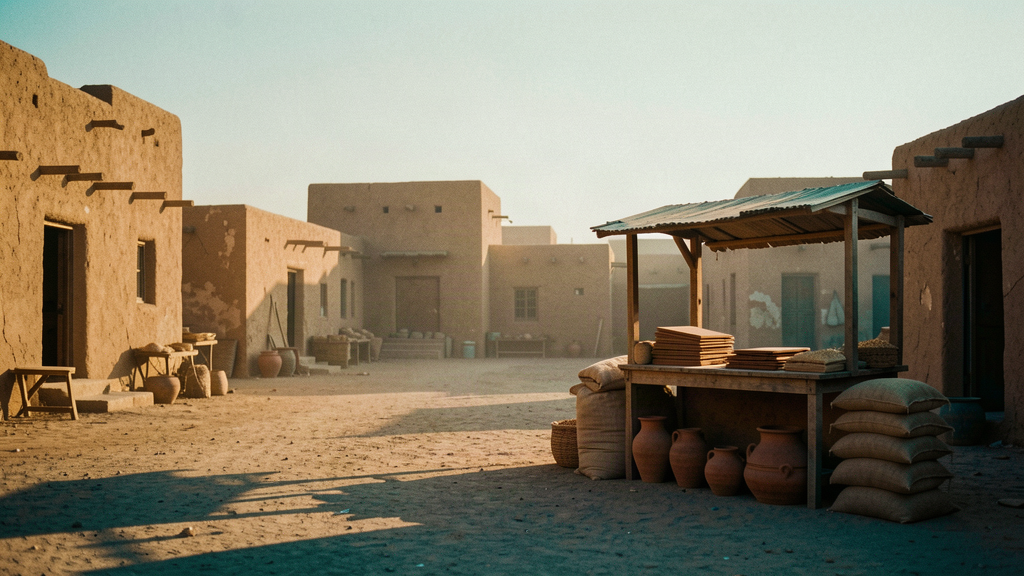
Trade is older than every government on Earth. Before the first coin, before the first tax, before the first law, people were already exchanging - and nobody planned any of it.
Nobody Taught You to Trade
Think about the last time you traded something. Maybe you sold a chair on an online marketplace. Maybe you swapped shifts with a coworker. Maybe you handed over four dollars for a coffee this morning. Did you take a course first? Did you read a manual? Did you wait for permission?
Of course not. You just did it. You had something, someone else wanted it, and you traded.
Children do this before they can read. Watch a kid negotiate a trade of snacks or trading cards and you will see the whole science in miniature: the offer, the counteroffer, the instant sense of when a deal is unfair. Nobody teaches this. It is not in any curriculum. Because it is older than every curriculum.
That is the fact the modern world rests on, and it is the easiest one to forget: exchange is not something people have to be taught, persuaded, or organized into. It is what people do when they are free to do it.
In the first article of this series, The Name Is the First Argument, we saw how the enemies of the market got to name it. In the last, The Great Escape, we tell the story of the escape from poverty that exchange made possible. Now let us go back further - before the name, before the escape, before money itself - and ask where exchange came from.
The answer begins with a story the textbooks tell. The story is mostly wrong.
The Story the Textbooks Tell
Open a textbook to the chapter on money and you will meet the barter myth.
Once there was a village, the story goes. The potter had more pots than she needed. The farmer had more grain. So they swapped: two pots for a sack of grain. But barter was awkward. What if the potter did not want grain? What if the farmer wanted fish and the fisher wanted pots? The whole village could spend its days hunting for someone who happened to want what you had. So people invented money - a convenient thing everyone would accept - to make exchange easier. And then the state arrived, to stamp the money, guarantee it, and organize the whole affair.
Adam Smith told a version of this story in The Wealth of Nations in 1776: the division of labor, then barter, then money as the natural solution to barter’s difficulties. It is an elegant story, and it is the one most of us were taught.
Notice what the story smuggles in. If exchange began as a clumsy thing that needed a clever invention to fix it, then exchange is a technology - something that was designed, and therefore something that can be redesigned. If money works only because the state guarantees it, then the state is the author of the economy. The history lesson carries a political payload: exchange was invented, so the people who manage it are entitled to improve it, direct it, or replace it with something better.
There is only one problem with the story. According to the available evidence, it’s not true.
What the Tablets Say
The oldest writing humans ever produced is not poetry. It is not prayer. Quite simply, it is bookkeeping.
Around 3000 BC - more than two thousand years before the first coin was struck - scribes in Mesopotamia were pressing marks into wet clay to record who owed what to whom. Loans made. Grain advanced. Interest promised. The tablets that survive are receipts, contracts, and ledgers, and they are the earliest documents of civilization. The history of accounting begins here, in the mud of the river valleys, with people keeping track of their deals.
Think about that for a moment. The first things our species ever wrote down, as far as we know, were records of exchange. People were trading - and keeping careful records of their trading - long before there was anything you could hold and call money.
The scholar David Graeber built a famous book on this evidence. In Debt: The First 5,000 Years, he argued that credit and debt came before coinage, and that the barter story was never observed anywhere - a myth invented to explain something that never happened. Other scholars dispute parts of his argument, and reasonable people can disagree about the details.
But here is the point that survives the argument either way. Whether the first exchanges were settled in grain, in promises, or in marks on clay, the lesson is the same. Exchange emerged from the bottom up, person by person, deal by deal. Money came later, as a solution to problems that exchange itself created. No committee designed the system. No planner oversaw it. It designed itself, one deal at a time.
The Engine
Why did people exchange at all? Because of a simple idea: if I spend my days making pots and you spend yours growing grain, we both get better at our own work - and when we trade, both of us end up with more than either of us could produce alone.
This is the division of labor, and it is the engine of everything that followed. We explored it in Competition and Co-operation: how the potter, the farmer, and the fisher each do what they do best, and how their separate efforts add up to a whole that none of them could have produced alone.
Nobody assigned the roles. Nobody held a meeting to decide who would be the potter and who would grow the grain. The potter became the potter because she was good at it, or because the clay was hers, because her parents did it or just because she liked doing it. The farmer became the farmer for his own reasons. The roles emerged the way paths emerge across a field: from the most convenient routes people take when walking.
And the two discoveries fed each other. Specialization makes exchange valuable - why else would the potter and the farmer bother? Exchange makes specialization possible - the potter can give up farming only because she knows the farmer will have grain. Neither half of the machine works without the other, and nobody assembled the machine.
The heroes of this part of the story have no names, because nobody thought to write them down. The potter whose hands learned the clay. The farmer who saved the best seed. The trader who crossed the desert twice because the first trip paid. That trader is the emblem of this whole series: someone who took a risk, served other people on the way, and came home richer for it. He did not know he was building the global economy. He was just trying to make his own life better - and in the doing, he made everyone else’s life better too.
The Market Square
Now picture the market square, in any town, in any century - before the 20th, before the experiments with ‘alternative’ economic systems.
The baker has bread. The smith has iron. The woman at the corner stall has cloth she wove herself. Nobody is in charge of the square. There is no manager, no price-setter, no official deciding what anything is worth. Each of them came for his own reasons. Each of them will leave having served the others.
The prices that emerge there were set by no one. The baker does not know what the smith’s iron costs to make; the smith does not know what the baker paid for flour. Yet the exchange works anyway, because both of them know a good deal when they see one. The square is a machine for turning private knowledge into public prices - and it runs on a quiet guarantee: that what you make is yours to keep and trade. Property Rights - The Foundation You Never Notice examines that guarantee, the assumption so basic that we stopped noticing it.
Thomas Hobbes called the natural condition of mankind solitary, poor, nasty, brutish, and short. He was describing war - what happens when the common power collapses. But the tablets and the market square tell us something the philosophers missed: the natural condition of mankind also included exchange. Obligation. Trust between strangers. Deals kept because keeping them paid. John Locke saw this side of it - he placed property and exchange in the state of nature, before any government existed - as Max Weber explores in Locke’s Ghost.
That is the spine of this series, and it is worth stating plainly: no one made this happen. Money, banking, trade - every institution we will meet in the episodes ahead was problem solving by humans for humans, person by person, deal by deal, over centuries. No committee. No decree. No planner. No mastermind. That is the plot.
The Imposers Arrive
Exchange was never the problem. The problem arrived the first time someone with power looked at the market square and saw something he could tax, direct, or simply take.
The record of control is as old as the record of exchange. Kings discovered that money could be quietly debased - melted down and re-struck with less silver - a hidden tax on everyone who trusted the coin. In the year 301, the Roman emperor Diocletian decided the market square had gotten out of hand and fixed every price in the empire by decree, from grain to labor. His Edict on Maximum Prices survives in fragments, a monument to the oldest economic error: the belief that someone at a desk can know what a market knows. It failed within years, the way such edicts always fail. Goods vanished. And the black market quietly did what the market square had always done, without the emperor’s permission.
Then came the monopoly charters, the grants of the right to be the only ones allowed to trade. Then the tariffs. Then the sumptuary laws, the rules about who could wear what and sell what and travel where. The ancient art of strangling trade is almost as old as trade itself. The imposers have been at this for millennia - and the market square has outlasted every one of them.
The Lens
So the next time you hear that the economy needs to be designed - managed by a ministry, directed by a plan, saved by a committee - remember the order of events. Exchange came first. Government came later. Money was born in the market, not in a mint. Every attempt to control exchange from a desk has a record of failure measured in millennia, and the market square is still standing.
The question to ask is simple. Next time someone tells you trade needs to be organized, ask: when did exchange ever need permission to begin?
This is the third article in the series, ‘The Natural Condition of Mankind.’ Start here: The Name Is the First Argument