


The Data That Changes Everything
In 1970, six out of every ten humans on earth lived in extreme poverty. By 2020, fewer than one in ten did.
Let that sit for a moment.
That is not a small improvement. It is the single greatest reduction in human suffering in the history of our species. It happened in my lifetime. It happened faster than any economic transformation in recorded history. And it happened because of two things the people who claim to care about the poor have spent decades attacking: capitalism and globalization.
Consider what “extreme poverty” actually means - not as a statistic, but as a lived reality. It means not knowing where your next meal comes from. It means watching your children die of diseases that cost pennies to treat. It means sleeping on dirt, drinking from a river also used for sewage, and never once believing your children will live differently.
In 1970, that described the majority of the human race.
Today, the World Bank estimates that roughly 9 percent of the global population lives below the international poverty line. The decline has been consistent across decades, interrupted only by temporary shocks, resuming its trajectory each time.
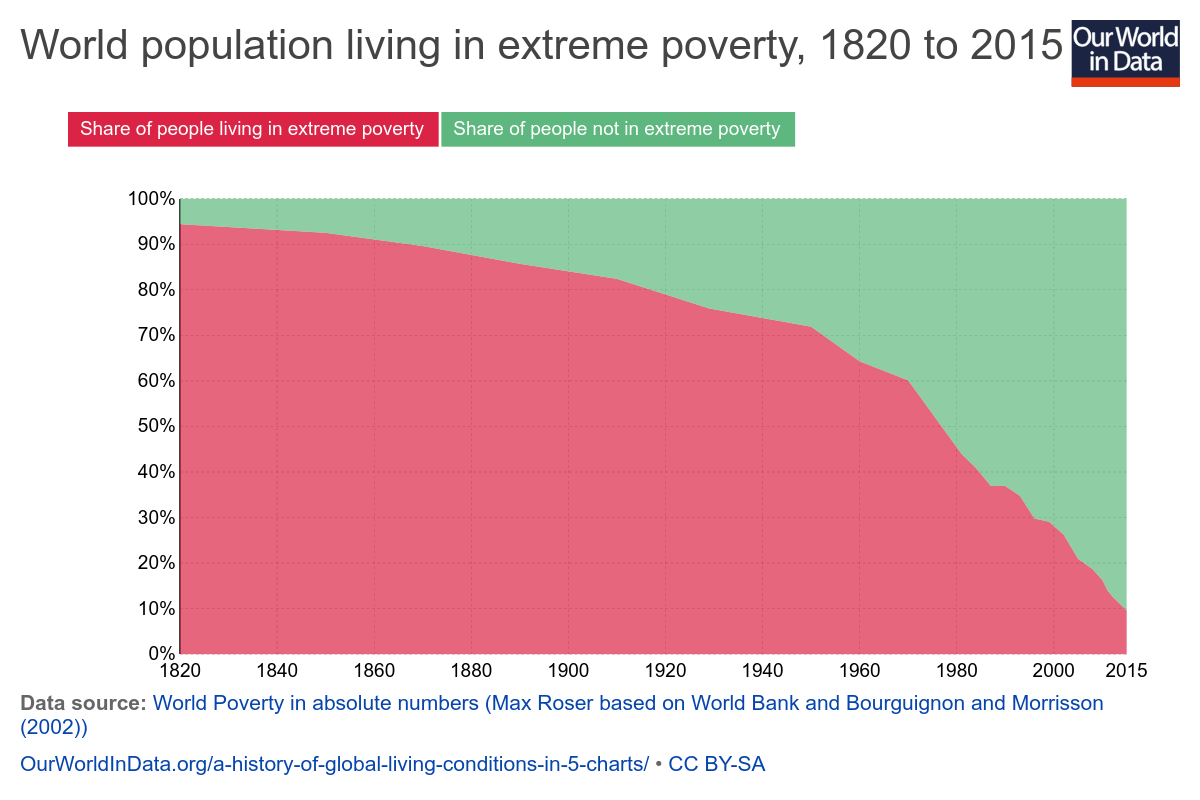
World population living in extreme poverty, 1820 to 2015. Source: Our World in Data / World Bank. CC BY.
Gapminder’s animated bubble charts show this in motion better than any static image can. The data is not controversial. The direction is not ambiguous. The question is why almost nobody knows about it.
Who Told You This Story?
Hans Rosling spent his life trying to make people see this data. A working doctor who treated patients in some of the poorest places on earth, he went on to become a global public health researcher and, eventually, one of the most effective data communicators who ever lived. He called our collective ignorance the “overdramatic worldview” - the instinct to assume everything is getting worse when, in fact, almost every measure of human wellbeing is improving.
Life expectancy up. Child mortality down. Literacy up. Violent crime down. War down. Democracy up. The list is long and the direction is the same. Dollar Street, one of Gapminder’s most powerful tools, lets you see this for yourself - photographs of homes at every income level around the world, sorted by monthly income. You can start at the bottom and scroll up. The change is visible. Real. Documented.
Rosling was evidence-based, humble, relentlessly cheerful, and never once told you that you deserved to feel guilty for being alive. He pointed at the data, showed you that things were better than you thought, and asked you to update your worldview.
He is the anti-Thunberg. Where one offered facts and hope, the other offers moral panic and a demand that you feel bad. It is a curious thing that the world embraced the latter and largely ignored the former - but then, grievance is more profitable than gratitude, and panic sells better than perspective.
What Actually Worked
The countries that escaped poverty did one thing: they opened their economies. They joined global supply chains. They let foreign capital in. They let their people work.
South Korea in the 1960s was poorer than North Korea. It had no natural resources. It had been devastated by war. What it had was a government that eventually allowed its people to trade with the world, build factories, and keep enough of what they earned to make the effort worthwhile. Today, South Korea is a wealthy democracy. The difference between the two Koreas is not geography, culture, or natural resources. It is economic freedom. We explored this more fully in Trade: Why Both Sides Win and The Vietnamese Boom.
China lifted more people out of poverty than any society in history - roughly 800 million - starting when Deng Xiaoping abandoned central planning and allowed markets to operate. The same pattern repeated across Southeast Asia, in India after 1991 reforms, in Vietnam, in Bangladesh. Everywhere the formula was the same: open the economy, integrate with global supply chains, let people work.
The countries that stayed poor did one thing too: they had oppressive, kleptocratic governments - most of them calling themselves socialist - that controlled the economy, extracted the wealth, and suppressed the entrepreneurship that could have freed their people. Zimbabwe under Mugabe. North Korea. Cuba. Venezuela. The pattern is as consistent on the failure side as on the success side.
You would think this would be celebrated. You would think the people who claim to care about the poor would point to the mechanism that actually helped them, study it, and try to extend it.
But the opposite has happened. The very forces that saved a billion people from starvation are now the primary villains of political discourse. Capitalism is blamed for inequality. Globalization is blamed for job displacement. Trade is blamed for cultural erosion. Profit is blamed for everything.
This should make you suspicious. Not because capitalism and globalization are perfect - they are not. They have real problems, and honest people acknowledge them. But when the only system that has ever lifted billions out of poverty is attacked by the very people who claim to care about the poor, something else is going on.
The rest of this article is about what that “something else” is.
1. Inequality - the Question Nobody Asks
The grievance: inequality is too high. The top 1% has too much. The gap is at Gilded Age levels. Something must be done.
The question nobody asks: what is the concrete harm?
Name one thing Elon Musk has taken from you. Not “the system” - him, personally. You cannot, because he has not taken anything. He sold products people wanted and got rich doing it. The same is true of Jeff Bezos, of Bill Gates, of almost every name on the rich list. They built companies, hired people, created products, and were rewarded by the voluntary choices of millions of customers.
If two runners finish a marathon - one in three hours, one in five - the outcome is unequal. But nobody was wronged. The gap is a description, not a grievance. What makes something unjust is not that outcomes differ, but that someone was cheated, coerced, or defrauded along the way. This is the foundational category error of modern progressive politics: conflating inequality with injustice. Injustice requires a victim and a perpetrator. Inequality requires only a calculator.
We have written about this in detail - the numbers on billionaire wealth, why the obsession with the top 1% distracts from the real problems of the bottom 20%, and why wealth taxes have a poor track record. Read Why You Shouldn’t Care About Billionaires for the full treatment, and California’s Wealth Tax for a case study in how these policies actually play out.
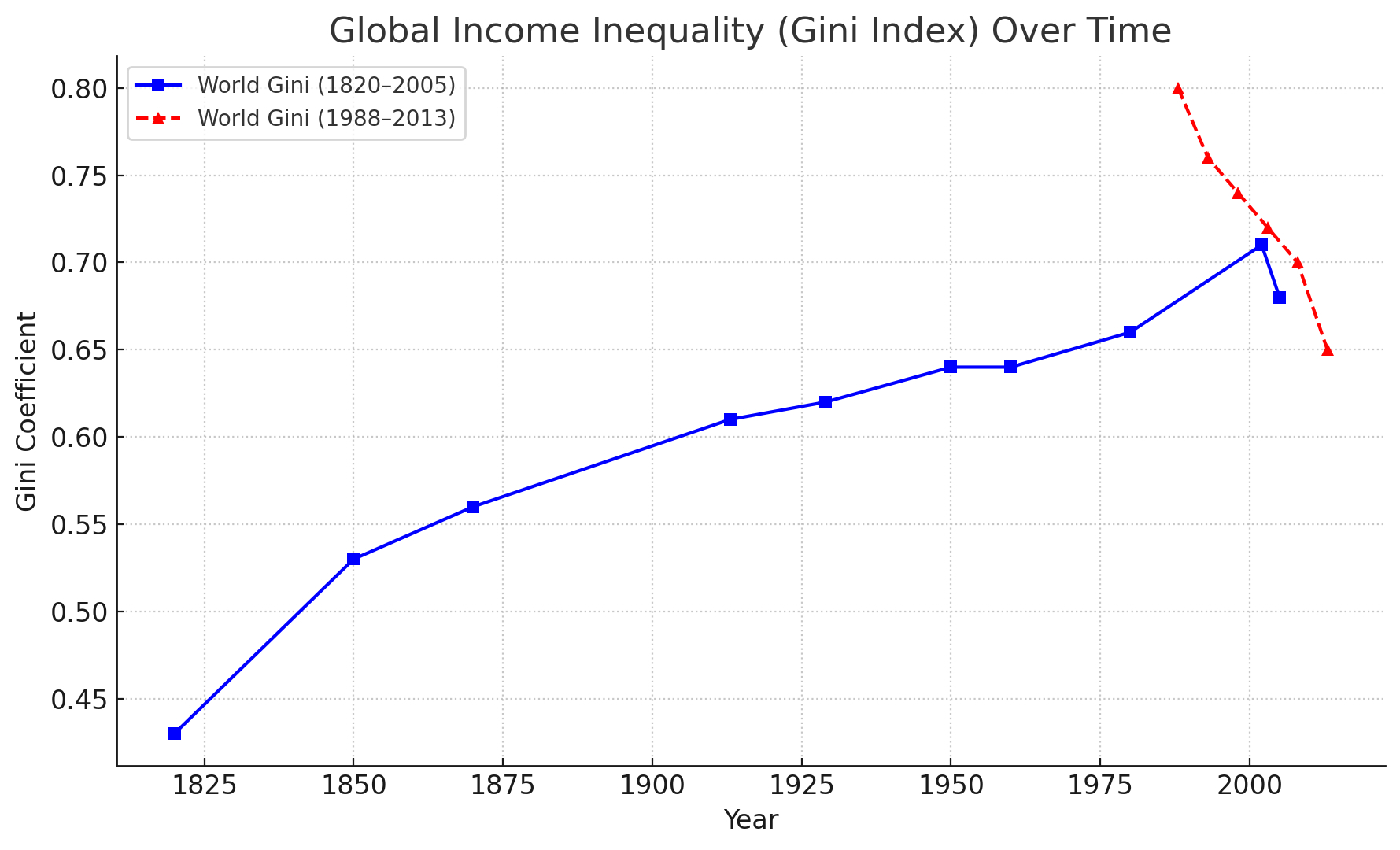
Global income inequality (Gini Index) over time. Note the long-term decline in between-country inequality as poor nations caught up. Source: Wikimedia Commons. CC BY-SA 4.0.
A Brief Detour: “Trickle Down”
At this point someone will say: “you’re defending trickle-down economics.” This is worth addressing because the phrase is one of the most effective rhetorical traps in modern political debate.
The phrase was invented by critics to describe something its advocates never proposed. No serious economist has ever argued that cutting taxes on the rich will, by itself, lift the poor. What the data actually shows is that economic growth - driven by investment, innovation, trade, and the rule of law - raises living standards across the board. The poor benefit most, because they start from the lowest base. This is not “trickle down.” This is “the tide lifts all boats.”
The 60% to under 10% poverty reduction is the tide. Every Vietnamese factory worker who went from $2 to $10 per day is the tide. Every Bangladeshi woman who left subsistence farming for a garment factory job - the tide. The mechanism is not charity. It is allowing people to create value, trade freely, and keep enough of what they earn to have an incentive to do it again. Calling it “trickle-down” is a rhetorical trick designed to dismiss the argument without engaging with it. Do not fall for it.
2. Relative Poverty - the Statistical Ghost
The grievance: too many people are poor. The solution: more redistribution.
The European Union defines relative poverty as living below 60 percent of median income. Here is what that means in practice. When the economy grows, median income rises. When median income rises, the poverty threshold rises. And the number of people classified as “poor” stays the same, or even goes up - even though everyone is richer than they were before. A person at the 20th percentile in Germany today has running water, central heating, a smartphone, free healthcare, and more food than they need. In 1970, they would have been considered comfortably middle class. But today they are officially “poor” - because someone at the 80th percentile has more, and that comparison is built into the definition.
This is not poverty in any historical or global sense. It is positional envy, reclassified as a policy crisis. The statistic is a Dead Man’s Switch - designed to scream emergency forever, no matter how prosperous people become. The One Lesson explains the principle at work: the seen versus the unseen, and why bad measurement leads to bad policy.
3. Greedflation - Same Story, Same Failure
The grievance: corporations used inflation as cover to gouge customers. The solution: price controls.
If supermarkets can set any price they want, why does Aldi exist? Why does anyone walk past one store to go to a cheaper one? Competition is the mechanism that prevents gouging, and grocery margins - typically 1 to 3 percent - did not spike during the inflation period. The price increases were driven by upstream costs: energy, transport, currency, regulation. Not greed.
The proposed solution, price controls, was tried in the 1970s under President Nixon. It caused shortages, empty shelves, black markets, and rationing. The policy failed, was abandoned, and is now being proposed again by people who either do not know this history or do not care. For the full story: Price Controls: A Lesson We Keep Unlearning. For how prices actually work: How Prices Work.
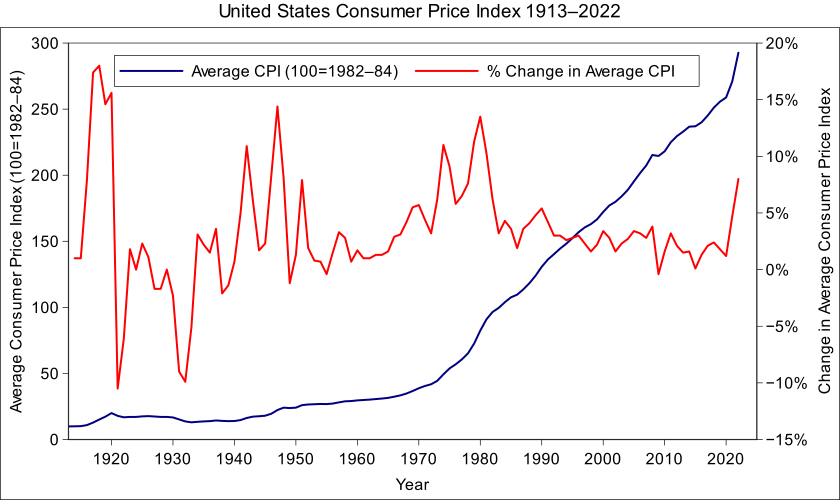
U.S. Consumer Price Index, 1913-2022. The long-term trend is upward, but the 1970s spike and the post-COVID spike are both visible. The proposed solution - price controls - was tried after the 1970s spike and failed. Source: Wikimedia Commons. CC0.
4. Climate Taxes - the Technocratic Failure
The grievance: carbon taxes will reduce emissions and stop dangerous warming.
The intention is good. Climate change is a real problem, and honest people disagree about the best way to address it - as we explored in Externalities: When the Price Is Wrong.
The question here is narrower: have carbon taxes worked in practice?
France introduced a carbon tax on fuel. It triggered the Gilets Jaunes - the largest protest movement in modern French history. Hundreds of thousands of ordinary people took to the streets, not because they were selfish or climate deniers, but because the tax fell heaviest on the people who could least afford to change their behaviour. The tax was abandoned. The emissions impact was negligible.
The response from advocates: we did not tax enough. Never question the theory. Never ask whether the mechanism actually works. Just demand more power. This is the grievance machine’s signature move.

The Gilets Jaunes (yellow vests) protest in Paris, January 2019. The largest protest movement in modern French history was triggered by a carbon tax on fuel. The tax was abandoned. Source: Wikimedia Commons. CC0.
5. Everyone Must Go to University
The grievance: university access is unequal. The solution: more government subsidy, easier access, free tuition.
Before the 1990s, university in Britain was genuinely free - tuition paid, maintenance grants provided - but only about 2 percent of school leavers attended. It was an elite institution serving a narrow slice of the population.
Then Tony Blair set a target of 50 percent participation. The number had no basis in evidence - not a study, not an analysis of labour market demand, just a round number announced as a goal. Universities expanded. Entry requirements fell. Tuition fees were introduced - initially £1,000, eventually £9,000 - paid through income-contingent loans written off after 30-40 years. Credential inflation set in at both ends: more graduates competed for the same jobs, and universities were pressured to award higher classifications to avoid student complaints. A first-class degree in 2020 was roughly equivalent to a 2:2 in 1990. The signalling game had escalated beyond what was rational.
The deeper point: the government created this problem through its first intervention (elite, class-based system) and worsened it through its second (arbitrary expansion target, loans). The proposed third intervention will produce more unintended consequences. The Information Problem explains why central planners cannot know how many graduates the economy needs, or what skills they should have.
6. The Internet Ban - Moral Panic as Policy
The grievance: phones and social media are destroying children’s mental health. The solution: ban or restrict them.
The question nobody asks: whose job is it to raise children?
The evidence for the claim is remarkably weak - correlation studies with small effect sizes, competing explanations barely addressed, almost no randomised controlled trials. It does not support the sweeping policy response being proposed. We covered this in The Cracked Screen.
Yet Australia has banned under-16s from social media. The UK and EU are moving in the same direction. The momentum is political, not empirical. Many actual technocrats - people who build and run the systems being regulated - know the bans are doomed: circumvented, unenforceable, counterproductive. But nobody can say this out loud, because the entire moral panic depends on the premise that something must be done.
The parent already has the most powerful tool for managing screen time: they can take the phone away. The state has no such relationship with your child. The Free Market Is More Democratic explains why this pattern is not an accident - markets allow millions of families to make different choices, while one-size-fits-all regulation forces everyone into the same mould, chosen by the people with the most political power.
7. The Pattern
Six different grievances. Six different villains. One solution in every case: more government power.
| Problem | The Grievance | The Villain | The “Solution” | Previous Attempt | What Happened? |
|---|---|---|---|---|---|
| Inequality | The rich have too much | Billionaires | Wealth tax | France, Sweden | Abandoned - capital flight, administrative costs exceeded revenue |
| Relative poverty | Too many are poor | “The system” | More redistribution | EU welfare states, decades | Metric unchanged - definition ensures it cannot improve |
| Food inflation | Corporations are gouging | “Greedflation” | Price controls | US, 1970s | Shortages, black markets, abandoned |
| Climate change | Planet is warming | CO₂ emitters | Carbon taxes | France, Gilets Jaunes | Abandoned after protests, negligible impact |
| Opportunity | University access unequal | “50% target” / loans | More subsidy, free tuition | UK, 1999 onward | Credential inflation, arbitrary target, each intervention created the next problem |
| Kids & screens | Children are being harmed | Tech companies | Ban / restrict | Australia (too new to evaluate) | Technocrats expect failure - circumventable, unenforceable, counterproductive |
The same political coalition proposes every one of these policies. The same pattern of failure repeats. The same response - “we did not go far enough” - follows each failure.
This is not governance. This is oppression.
8. What the Grievance Machine Hides
The grievance machine does not want you to know about the 60% to under 10% poverty reduction, because if you knew things were getting better, you might not hand over the keys.
It does not want you to know that what kept most of that 60% poor were their own oppressive, kleptomaniac governments - regimes that controlled the economy, extracted the wealth, and murdered anyone who tried to build something outside their control.
It does not want you to know that the countries that escaped poverty did so by opening their economies - embracing the very capitalism and globalization now blamed for every ill.
It does not want you to know this because the entire grievance narrative depends on you believing things are getting worse. If you knew they were getting better - dramatically, historically, measurably better - the entire edifice collapses.
The Lens
Next time you hear someone demand action on any of these grievances, try a simple test.
First, ask what the concrete harm is. Not “the gap is too big” - what is the actual injury, and who suffered it?
Second, ask whether the last intervention actually worked. Not “we need to do more” - what was the result the last time we tried this?
If they cannot answer both questions, you are not listening to a problem-solver. You are listening to someone blowing a dog whistle.
And the dog is supposed to be you.
This is the first article in a two-part series. Next: Max Weber on who profits from the grievance machine and the question you have to answer.