


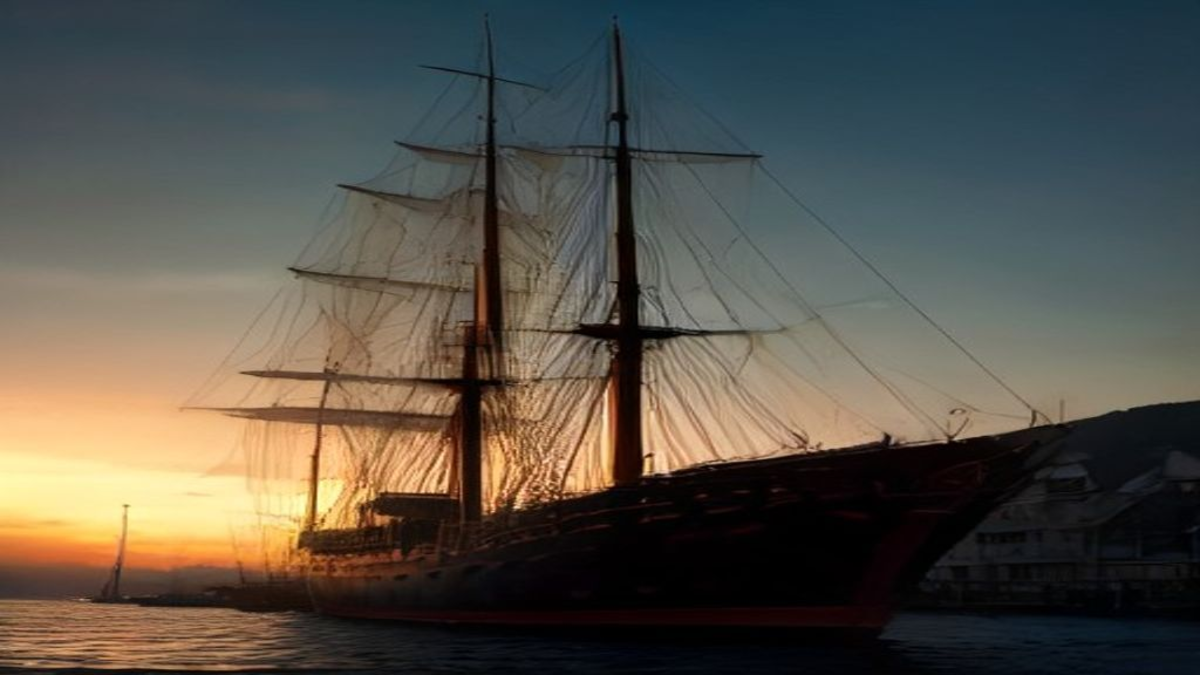
Trade is the oldest institution in this series, and the most strangled. The first merchants crossed open water before the first empire existed, carried the alphabet around the Mediterranean, and opened a road across Asia that nobody ever surveyed. Then the state arrived at the dock - and everywhere it landed, its first acts were the same: tax the cargo, license the trade, and keep the best of it for itself.
The City That Never Conquered Anything
In the last article we watched the counting house become the bank, and the state arrive late to claim it. This is the rest of that story. Before the bank, before the coin, before the first ledger was pressed into clay, there was the cargo.
The people who first built their lives around other people’s cargo lived on a narrow strip of coast that is now Lebanon. The Greeks called them Phoenicians - the purple people, after the dye they sold. They had no empire and seem never to have wanted one. What they had was cedar for shipbuilding, a coastline full of harbors, and an unshakeable habit of looking at the sea and seeing a road.
Their cities - Tyre, Sidon, Byblos - were trading posts that grew into cities, not cities that grew into conquerors. They sailed the length of the Mediterranean, through the Pillars of Hercules into the Atlantic, and traded for tin from Britain. They founded Carthage on the coast of North Africa, according to tradition in 814 BC, and Carthage grew into the greatest trading city the ancient world ever saw.
And they gave us the alphabet.
Here is a fact worth knowing: the letters you are reading right now are descendants of the script the Phoenicians carried around the Mediterranean. The Greeks took their letters and added vowels. The Romans took the Greek letters and shaped them into our own. A Phoenician trader’s mark became the A on this page. Nobody decreed this. No committee designed it. It spread the way trade spreads - because every person who adopted it was better off with it than without.
The most famous thing they sold was the purple. It took tens of thousands of murex snails to dye a single robe, and the finished cloth was worth several times its weight in gold. For two thousand years, purple was the color of power, and it all came from the docks of Tyre.
The city itself ended the way trading cities end when a conqueror arrives. Alexander the Great besieged Tyre for seven months in 332 BC, building a causeway out into the sea to reach the island city, and when it fell he razed it. A city of merchants had held the conqueror of the world at bay for half a year, and he could not forgive it.
Think about what the Phoenicians prove. Here was a civilization with no army to speak of, no empire, no grand plan - and it changed the world more than most conquerors did. It imposed nothing on anyone. It traded, and the world came to it.
The Road Nobody Built
Now the largest trade route in history - and the strangest thing about it is the name.
The Silk Road was not called the Silk Road while it worked. The name came in 1877, from a German geographer, Ferdinand von Richthofen, writing a survey of China - centuries after the great age of the caravans was over. The same thing happened to the word capitalism, as we saw in the first article of this series: the system worked for centuries without a name, and the name came later, from outside. The road never needed a name to move goods.
The road itself was not a road. It was a web of paths across the greatest landmass on earth, stitched together by oases and passes and markets. No one built it. No single ruler surveyed it, maintained it, or policed it. It ran because every link in the chain was a deal that made both parties better off: the caravan that crossed the desert twice did so because the first trip paid, and the oasis town that fed the caravan did so because the caravan paid in silver. The whole web was mutual gain, person by person, deal by deal - the plot of this series.
The Chinese court found the route by accident. In the 130s BC, the Han emperor Wu sent an envoy named Zhang Qian west to find allies against the nomads who raided his border. Zhang Qian came back years later without the allies - and with something better: the knowledge that the world to the west was full of buyers. The emperor understood what he had learned. Silk went west. The horses the Chinese cavalry needed came east. So did jade, glass, wool, and spices.
Ideas traveled on the same paths. Buddhism moved east into China along the trade routes. Papermaking made its way west along them. Trade carried more than goods; it carried the accumulated discoveries of every culture it touched, and every culture was richer for the contact.
The theory of why both sides win is in Trade - Why Both Sides Win, and the deepest form of the argument is in The Deepest and Most Beautiful Insight in Economics. The Silk Road is the empirical proof: for fifteen hundred years, goods moved across half the planet with no planner, no trade agreement, and no tariff union - only the quiet arithmetic of people who were better off for the deal.
The League Without a King
If the Silk Road shows trade without a ruler, the Hanseatic League shows trade building its own institutions.
In the thirteenth century, the merchant towns of the North German coast discovered that they traded more successfully together than apart. Out of that discovery grew the Hanseatic League - a commercial confederation of towns that lasted from the thirteenth century to the seventeenth, with no king at its head. The leading city was Lübeck, itself a merchant town, which had grown rich on the herring and salt that fed half of Europe.
The League’s foreign trading posts were called kontore. There were four great ones: London’s, known as the Steelyard; Bruges; Bergen; and Novgorod. Each was a small fortress of the market - a walled compound where Hanseatic merchants lived under their own rules, with their own warehouses and their own courts, in the middle of someone else’s city. The goods they moved were the necessities of the age: herring, salt, timber, wax, furs, and cloth.
No monarch founded the League. No parliament chartered it. The merchants organized themselves because organizing paid. When kings wanted the League’s trade, they negotiated privileges with it as one power to another. A league of traders had become a power in its own right - without conquering an inch of anyone’s land.
The Charter That Was a Leash
And that is where the state enters - not as a builder this time, but as a customer with a key.
By the end of the sixteenth century, trade had grown so large and so profitable that the crowns of Europe wanted in. The English were late to the spice trade, and Queen Elizabeth I was not about to let the Dutch keep it all. On December 31, 1600, she granted a charter to the Governor and Company of Merchants of London trading into the East Indies - the exclusive right to English trade east of the Cape of Good Hope, for fifteen years. The East India Company was born. Two years later, in 1602, the Dutch formed their own United East India Company, the VOC - the first company in history to sell shares to the public that could be freely traded.
Note what the charter was. It was not a permission to trade. It was an exclusive right to trade - a monopoly, granted by the crown. The state did not create the spice trade; the Portuguese had been sailing those routes for a century, and the Dutch and English followed the routes the Portuguese opened. What the crown created was the privilege. Trade was born free. The charter was the leash.
Adam Smith saw it plainly. In The Wealth of Nations he argued that the chartered companies were not free trade but its opposite - the state selling exclusivity to a favored few, and the consumer paying the difference in dearer goods. The monopoly was the strangulation, wrapped in a royal favor.
The East India Company’s own history proved the point from both ends. It began as merchants and ended as rulers. After the Battle of Plassey in 1757, it collected taxes and governed provinces in India. By the nineteenth century it was less a trading company than an empire with a ledger, and its monopoly was being chipped away - Parliament ended its exclusive hold on the India trade in 1813 - until, after the rebellion of 1857, the crown simply took over India outright in 1858. The company that began as the state’s favorite became the state.
The pattern is the one we met in the last article, and it bears repeating: the market built the trade. The state arrived late, and its first acts were to claim, to license, and to tax.
The Ancient Art of Strangling Trade
Every civilization that touched trade discovered the same three tools. None of them looks like an attack on trade, which is why they have survived so long.
Tariffs. The tax on exchange is the oldest revenue in the book. It looks like a tax on the foreigner, which is precisely why it works politically and fails economically: the foreigner does not pay it, the people at the dock do, in higher prices and thinner choices. The cost is invisible. You see the protected factory and the favored industry; you never see the goods that never arrived, the jobs that never existed, the cheaper prices that never happened. We have walked through this before in The Tariff Shell Game: A Policy That Keeps Failing - the modern version keeps failing and keeps returning, because the temptation never changes.
Monopoly charters. The state sells exclusivity. Elizabeth I and her successor James I handed out monopolies so freely - on salt, on starch, on playing cards - that Parliament finally rebelled and passed the Statute of Monopolies in 1624, voiding most of them. The charter looks like a favor. It is a leash on everyone else, and the leash is the point.
Sumptuary laws. The strangest of the three: the state telling people what they may wear. Rome reserved the full Tyrian purple for the emperor alone by the fourth century, and medieval kingdoms restricted furs and silks by rank. The most valuable goods of the age were not for the market - they were for the state’s friends. The detail is almost too perfect: the purple that made Tyre famous, the color of trade itself, became the one color the common citizen was forbidden to wear.
The seen and the unseen again. When trade is strangled, the strangulation is invisible, because what disappears is the trade that would have happened. The framework that makes this visible is in The Seen and the Unseen, and it is the oldest lesson in this series: the good economist and the bad economist differ only in what they count. The bad economist counts the tax revenue. The good economist counts the ships that never sailed.
The Lens
So the next time someone tells you trade is a modern invention - a corporate plot, something imposed on us - ask them two questions. Who carried the alphabet? And who was waiting at the dock with a tax?
The answers are the same every time. The merchant carried the alphabet, and the state was waiting at the dock. Trade was born free, and it has been wearing the state’s license ever since - not because it needed one to be born, but because the state arrived late and wanted a cut.
This is the sixth article in the series, ‘The Natural Condition of Mankind.’ Start here: The Name Is the First Argument. Previous: Banking and Credit. Also in the series: Before Money: Where Exchange Comes From, The Invention of Money, and The Great Escape: How Nine in Ten Humans Left Extreme Poverty