



In 2001, Swiss voters approved a rule limiting how much their federal government may borrow. Eighty-five percent voted yes. All twenty-six cantons voted yes. It entered the constitution as Article 126, took effect in 2003, and has not been touched since.
Eight years later, Germany adopted a version of the same idea. The structural deficit of the federal government was capped at 0.35 percent of GDP. The states were required to balance their budgets. Foreign commentators admired it. It was called the model fiscal rule.
Since then the German rule has been suspended for four consecutive years, had a hundred billion euro fund carved out of it by constitutional amendment, been enforced against the government by the Constitutional Court, and then had half a trillion euros and the entire defense budget exempted from it, again by constitutional amendment.
This is usually told as a story about the size of government. It is a better story about who can enforce a promise.
The rule everyone copies
Start with what the Swiss actually decided, because the design is the least interesting part.
The debt brake is an expenditure rule, and it is mechanical. Ordinary spending is tied to ordinary revenue, adjusted for the economic cycle. If the economy is running below capacity, the formula permits a matching deficit. If it is running above, it demands a surplus. No discretion, no negotiation, no annual vote on whether the rule applies this year.
That is elegant, but that is not why it works. Rules of this shape exist in a dozen countries, and most of them have been bent. What Switzerland has that Germany does not is a second institution sitting on top of the first.
The rule is enforced by referendum. Amending the Swiss constitution requires a double majority: a majority of voters and a majority of cantons. A parliamentary majority cannot do it alone, and neither can a coalition, a chancellor, or a court. A popular initiative needs 100,000 valid signatures within eighteen months to put a question to the country.
So when a Swiss government wants fiscal room it does not have, it cannot simply legislate for it. It has to win an argument with the electorate.
There is a second, smaller consequence that matters more than it looks. The escape hatch is priced. In an exceptional year the Confederation may spend outside the brake, but the excess is debited to an amortization account and has to be worked back down. The Swiss finance ministry has run extraordinary expenditure for seven straight years now, through the pandemic and then through the costs of people seeking protection from Ukraine, and it reports the accumulated shortfall as a debt to be eliminated rather than a precedent to be extended. Switzerland’s emergency spending is borrowed room with a repayment schedule.
What Germany did to its own rule
Now watch the same rule in a system where parliament is the only body that has to agree.
The German debt brake entered the Basic Law in 2009 and bound the federal government from 2011. It did not bind at full strength immediately: the structural ceiling of 0.35 percent was phased in along a reduction path, and on the German Council of Economic Experts’ own account it did not become fully binding until 2016. From 2016 to 2019 it worked, and the debt ratio fell.
Then the sequence began.
2020 to 2023. The brake is suspended, four years running, first for the pandemic and then for the energy shock. This is the rule’s own emergency clause doing what it was designed to do.
2022. A two-thirds majority amends the Basic Law to add Article 87a, creating a hundred billion euro fund for the armed forces that sits outside the debt brake entirely. The rule’s scope shrinks by constitutional amendment, and that process is the point.
November 2023. The Federal Constitutional Court strikes down the government’s plan to reallocate sixty billion euros of unused pandemic borrowing to the Climate and Transformation Fund. This is the enforcement mechanism working. Though a court, not the voter, held the government to the text.
March 2025. Sixteen months after that ruling, the Bundestag passes a constitutional amendment that puts a five-hundred-billion-euro infrastructure fund outside the brake, exempts all defense spending above one percent of GDP from it, and lets the states borrow up to 0.35 percent of GDP after years of being required to balance. The European Commission’s own assessment puts the infrastructure fund at 11.6 percent of 2024 GDP. Bruegel’s director called the amendment historic and projected German debt converging on 100 percent of GDP.
The importance of the date is worth noting. The twentieth Bundestag was elected in 2021. It was replaced at the election of 23 February 2025. It approved the amendment on 18 March 2025 and handed over to its successor on 25 March 2025. A parliament that the voters had already dismissed rewrote the fiscal constitution seven days before the new administration took office.
Under the Swiss rule, that amendment would have had to face the electorate. Under the German rule, it faced only the members it was written to bind.
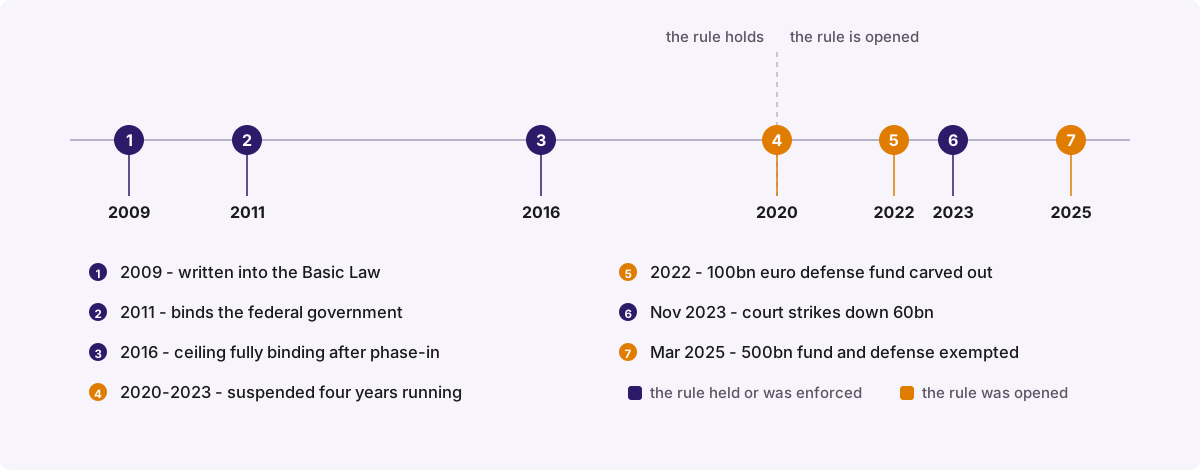
The rule held for eleven years and has been opened three times in six. Two of those openings were constitutional amendments, and the one occasion a court enforced the rule was overridden by amendment sixteen months later. Sources: Basic Law amendments of 2022 and of 22 March 2025; Federal Constitutional Court, 15 November 2023.
The difference is the enforcement, not the text
Set the two rules side by side and the text is nearly the same. An expenditure ceiling. A structural target. A cyclical adjustment. An emergency clause. If a fiscal rule were a piece of engineering, Germany’s would be a working copy of Switzerland’s.
The difference is what happens when a government wants out.
In Germany, a determined majority needs two-thirds of the Bundestag and two-thirds of the Bundesrat. The Basic Law’s eternity clause, which protects human dignity, democracy and the federal structure from amendment, does not mention fiscal rules. The debt brake is a constitutional provision like any other, and a constitution that can be amended by a supermajority will be amended by a supermajority when the pressure is high enough. The 2025 amendment is not an abuse of the system. It is the system working exactly as designed.
In Switzerland, no majority of any parliament can do it. The voters have to agree, and the voters are the people who pay.
This is where it is worth being precise, because the tempting version of the argument is wrong. It is not that Germany has no enforcement. It has a Constitutional Court, and in November 2023 that court blocked the government’s budget maneuver outright. Judicial enforcement is real. It is simply enforcement that a later supermajority can repeal. The Swiss brake is enforced by a body that cannot be overruled at all.
The cantons already ran the experiment
You do not have to reason from two countries. Switzerland has twenty-six of them, and most wrote their own fiscal rules, which makes the country the best natural laboratory anywhere for the question of whether a rule changes anything.
The founding result is Feld and Kirchgassner’s study of the twenty-six cantons from 1980 to 1998, before the federal brake existed. They tested three kinds of constitutional clause at once - fiscal decentralization, formal fiscal restraints, and direct popular rights - and reported a split that repays careful reading. Fiscal constraints significantly reduced budget deficits. Direct democracy led to significantly lower public debt.
Two different mechanisms, two different outcomes, in one paper, measured across the same cantons in the same years. That is the finding this piece has been circling, established two decades ago.
More recent work sharpens it. A 2026 study of the cantons from 1992 to 2021 tested not whether fiscal rules exist but whether they carry sanction mechanisms for breaking them, and asked what happens to spending composition during election periods. Cantons whose rules include sanctions show no statistically significant election-cycle distortion in their spending. Its title states what the data supports - Rules alone won’t do.
The pattern therefore has three levels of evidence behind it: two national cases, twenty-six cantonal ones, and a peer-reviewed result isolating sanctions as the variable that matters.
It also disposes of a claim that circulates whenever the Swiss case comes up, that the profession somehow ignores it. The cantonal literature is substantial. The Swiss Federal Finance Administration publishes compliance data every year. The Library of Congress maintains a research report on Article 126. Switzerland is studied thoroughly by economists. It is neglected in political argument, which is not the same thing.
Why this is not a story about frugal voters
The obvious objection is that Swiss voters must be unusually hostile to public spending. They are not.
On 3 March 2024 the same electorate that defends the debt brake approved a thirteenth payment to old-age pensioners, by 58.2 percent, carried by fifteen cantons to eight. They voted themselves a permanent increase in a large, popular, expensive program.
That result is the whole argument in one number. The people who enforce the constraint also vote for the spending. What they cannot do is vote for the spending and pretend it is free.
This is where the case connects to something this site has argued before about how hard it is to vote well. In Democracy’s Impossible Voter, the problem was that a modern election asks a citizen to judge a dozen policy domains at once, through an adversarial information environment, with the costs of each choice buried in a bundle. Nobody can do that, so voters fall back on identity.
A referendum on a spending rule is the opposite shape of question. It is narrow, it is priced, and the consequence lands on the person answering. You do not need to be an economist to know whether you want a thirteenth pension payment at the cost of a higher contribution. You need to be told the price.
The Swiss system does not produce better-informed voters. It produces narrower questions with visible bills. That is the mechanism, and it is worth separating from any claim about who the Swiss are.
What the numbers do and do not show
The debt figures need handling with care, because “Swiss debt” is at least three different numbers and the choice between them changes the answer by a factor of two.
| Measure | Value | Compiled by |
|---|---|---|
| Swiss net federal debt | 16.1% of GDP, end 2025 | Swiss Federal Finance Administration |
| Swiss general government, gross | around 30% of GDP | Swiss Federal Finance Administration |
| French general government, gross | 115.8% of GDP, Q2 2025 | Eurostat, Maastricht basis |
| German general government, gross | 62.4% of GDP, Q2 2025 | Eurostat, Maastricht basis |
Two cautions. Switzerland is not an EU member, so it is not in the Eurostat series and the Swiss and EU figures are not compiled on identical definitions. And the 16.1 percent figure that circulates most widely is net federal debt, which excludes the cantons, the municipalities and the social insurance funds - it is a real number describing a much smaller thing than the comparison invites you to assume.
The direction of the gap survives every pairing. Though the precision does not.
What the Swiss case does not prove
Three concessions, as the tidy version of this argument is not defensible.
The brake covers the Confederation only. The cantons and the municipalities are outside it. Most cantons have their own brakes, and the academic work on Swiss fiscal rules has largely been done at the cantonal level, which is where the variation is. “The Swiss brake” is shorthand for a lattice of rules, not one mechanism doing all the work.
Low debt has other causes. Switzerland has had decades of growth, high immigration, a currency it borrows in cheaply, and a central bank that has distributed profits to the Confederation. A fiscal rule that binds contributes to a low debt ratio. It is not the only contributor, and a piece that credits it with everything is making an argument it cannot support.
Germany’s brake genuinely worked for a while. From 2016, when the ceiling became fully binding, to 2019, the ratio fell and the rule held. The German case is not a rule that never functioned. It is a rule that stopped functioning when the shocks arrived and the politics changed. Durability is the question, not efficacy.
There is a fourth concession that cuts against the whole framing. Direct democracy has costs. It is slower, it can produce incoherent bundles of its own, and it hands a great deal of agenda-setting power to whoever can organize 100,000 signatures. The claim here is narrow: on this specific question, over this specific period, putting the decision to the voters produced a binding constraint that a parliamentary system did not.
The pattern this fits
This site has argued before that the machinery of politics rewards policies with concentrated benefits and diffuse costs, and that the fix is not better people but better rules. In Public Choice Theory, the conclusion was that the incentives are the answer, and that electing more competent governments does not change the structure those governments operate inside.
The debt brake is what a serious attempt at changing the structure looks like. It is a rule designed by people who understood the diagnosis: if the incentive is to borrow and hide the cost, then bind the borrowing and make the cost visible.
And the two cases show that the design is not what decides whether the binding holds. A rule is a promise about the future made by people who will not be there. It only constrains if someone who is still there has the standing and the motive to enforce it. Germany’s brake is enforced by a court that a supermajority can overrule, and it has been overruled. Switzerland’s is enforced by the electorate, and no parliamentary majority can overrule them.
The same logic runs through the archive’s other work on accountability. The tariff review that nobody had to defend produced no accountability at all, because a review only bites when someone has to answer for the outcome. The Swiss brake is what it looks like when someone does. The German amendment is what it looks like when the only people who have to agree are the people who benefit from agreeing.
It also explains an asymmetry that otherwise looks strange. Handing a question to the voters is cheap, popular in principle, and constantly avoided in practice. France’s electorate rejected the European Constitutional Treaty in 2005 by 55 percent on a 69 percent turnout, and the substance returned as the Lisbon Treaty, ratified by parliament with no referendum. Ireland was the one member state constitutionally obliged to ask - and was asked twice, in 2008 and again in 2009, on a treaty text that had not changed. A vote that can be avoided will be avoided. A vote that binds cannot be.
That is the difference between the two countries, and it has nothing to do with how much either government spends. It is about whether the people paying for a decision are the people who get to make it.
Switzerland’s rule has held for a quarter of a century. Germany’s is being dismantled by the parliament that wrote it, in stages, with the courts doing their job in between. Both outcomes were available to both countries. Only one of them had arranged for the voters to be able to say no.
A companion piece to this argument is California’s Wealth Tax, which follows the other half of the same problem: what happens when the people a rule targets can simply leave. Exit and voice are two different constraints, and a rule that ignores either one will not hold.