


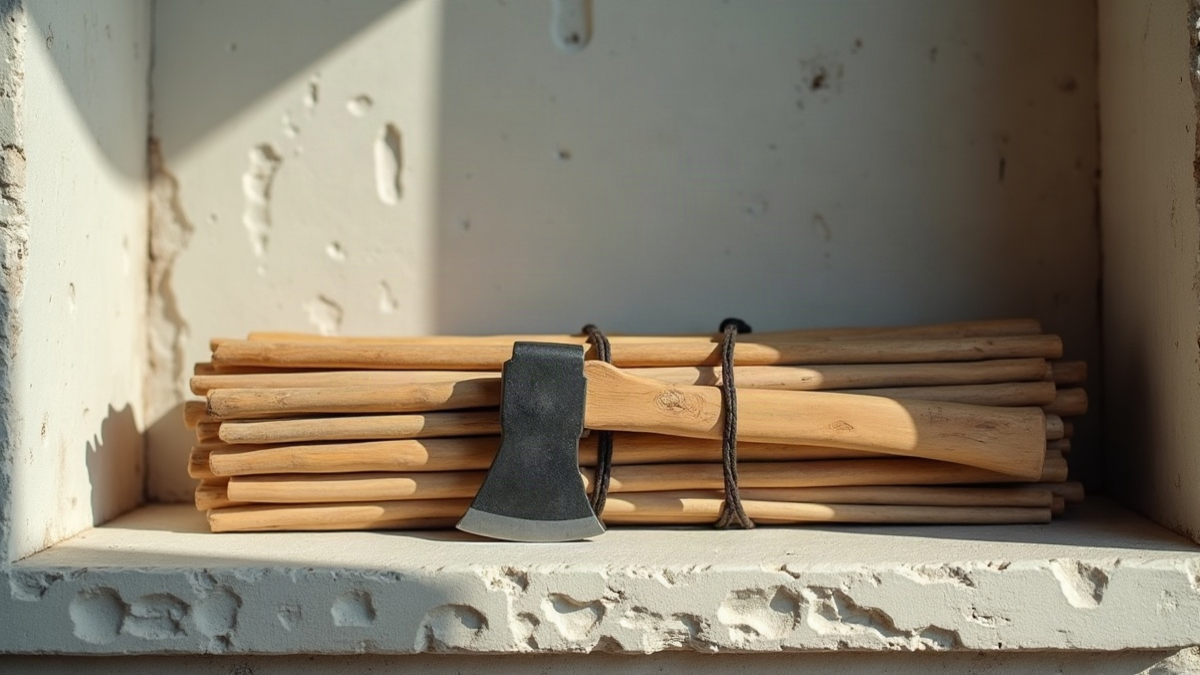
“Fascism” is the word we reach for once we have stopped arguing. It gets applied to tax collectors, school boards, and people who are rude on trains. A word that names everything names nothing - and the cost is not merely sloppy speech. It is that we have lost the ability to recognize the thing the word was invented for, which was specific, deliberate, and had an economics. The economics is where you can most easily identify it.
This is the fourth article in this series of imposed economic systems. We began with the market being born - exchange before money, money before the state, credit before the license. Then we turned to the imposed alternatives: the systems that were built rather than grown.
The first of these was feudalism, which needed castles, oaths, and a blessing to fix a person’s place at birth. The second was socialism, which began as a voluntary dream and ended by building a wall to keep its people in. The third was communism, which promised to abolish the state and needed a list and a police force to run the economy it seized.
Now comes the fourth. It is the one whose name has traveled furthest from its meaning, and it is the one where the mechanism is easiest to see, because fascism did not disguise what it was doing. It put it in the constitution.
The Name They Chose For Themselves
Start with the word, because in this series the word is always the first clue.
“Fascism” comes from the Italian fascio - a bundle, a league, a group bound together. It shares a root with the fasces, the bundle of wooden rods around an axe that Roman magistrates carried as the symbol of authority, and it is the same visual idea: many sticks that cannot be broken one at a time.
In 1919, Mussolini’s movement took the name Fasci di Combattimento, the fighting leagues. By 1922 his followers had marched on Rome and he was prime minister.
Now notice the pattern, because it is interesting.
- “Capitalism” was a word its critics gave to the thing they disliked.
- “Feudalism” was named centuries after the fact, by people who had every reason to make it sound worse than it was.
- “Socialism” was the first name the believers chose for themselves.
- “Fascism” was the second - and unlike socialism, it did not need a hundred years to be explained. It arrived with a doctrine attached.
That is what makes fascism worth looking into. It is not a vague mood or a personality type. It came with a theory of the economy, and that theory was written down.
The Corporate State
Let us state the case as its own supporters stated it, because they knew what they wanted better than anyone else. Their own summary of the state was blunter than anything their critics later wrote about them.
Quote
La nostra formula è questa: tutto nello Stato, niente al di fuori dello Stato, nulla contro lo Stato.
- Benito Mussolini, Milan, 28 October 1925
Everything in the State, nothing outside the State, nothing against the State.
That is the formula, and it is the one usually quoted from him. The version most often attributed to the 1932 Doctrine of Fascism entry in the Enciclopedia Italiana - written with the philosopher Giovanni Gentile and published under Mussolini’s own name - makes the same claim in prose: for the fascist everything is in the State, and no human or spiritual thing exists, or has any value, outside it. The two are routinely merged. They are a speech and its restatement seven years later, and the dates matter if the quotation is doing any work.
Read it as an economic claim first, because that is what it is. Nothing outside the State means no price agreed between two people, no firm that answers to its owners, no union outside the party, and no newspaper outside the license. Nothing outside the State is the whole program in five words: not a strong state, not a busy state, but a state with nothing left over.
The claim ran like this. The disease of the modern world is class conflict. Capital and labor are treated as enemies, each organized against the other, each striking and locking out, and in the middle stands a democratic state that is too weak and too bought to do anything but referee. The result is paralysis: strikes that stop production, parliaments that trade favors, and a nation that cannot act as a nation.
So far, so Karl Marx.
Their cure was to abolish the conflict by abolishing the two sides. Employers and workers would not bargain against each other. They would be organized into corporations - joint bodies covering a whole industry, containing both owners and workers, settling wages, hours, and conditions together under the state’s supervision. The class struggle would be replaced by class collaboration. Capital and labor would be partners in a national project, and the state would hold the ring.
This was legislated. The Charter of Labor, adopted in 1927, set out the rights and duties of the corporate order. By 1934 the corporations themselves existed as organs of the state. In 1939 the Italian parliament was replaced by a Chamber of Fasces and Corporations - the legislature of a system in which the unit of representation was no longer the voter but the industry.
And the offer was not stupid. To a country exhausted by strikes, inflation, and a parliament that seemed unable to govern, a system that promised order, production, and an end to the war between classes had real appeal. It offered to make the economy work as a single machine, with one hand on the controls.
That is the claimed version. Now look at what the hand on the controls has to do.
The Mechanism: Who Sets the Price
The corporate state published its method, and the method is a list of the things a market does by itself.
Prices. Fixed by the state and by the corporations, not discovered by exchange. Bread, rent, fares, and the cost of the goods the state cared about were set by authority and held there.
Wages. Settled the same way. Not bargained between a worker and an employer, but determined by the corporation, with the state behind it and strikes made a crime.
Unions. This is the part that is usually softened, but it should not be. The Rocco Law of 1926 recognized one confederation per industry, gave it a legal monopoly, and made independent unions and strikes unlawful. Germany did the equivalent in 1933, when the independent unions were dissolved and the German Labor Front took their place. The point was not to strengthen labor’s side of the bargain. It was to abolish labor’s side of the bargain. An organization that cannot strike is not a bargaining partner.
Firms. Ownership survived the outward form and lost the substance. A factory owner kept the title and the profit, and lost the decisions. What to produce, how much, at what price, with what materials, and whether to close or expand - those moved to the state and the party. Entry into an industry required permission. Exit required permission too, which meant a firm that the market would have killed stayed open, and a firm the market wanted was allowed to exist only if the plan agreed. We described the general shape of this in Price Controls - What They Are and Why They Backfire.
Autarky. The stated goal was national self-sufficiency. Italy launched the Battle for Wheat in 1925 and pushed the campaign hard after the League of Nations imposed sanctions in 1935. Germany’s Four Year Plan of 1936 set the same target. The idea was to stop depending on foreigners for anything the nation would need in a war. The consequence is arithmetic: growing wheat on land that is bad for wheat, and making chemicals and fuel at home at several times the world price, is a cost paid in effort by everyone in the country. Autarky is a tax levied in labor rather than in currency, and no one ever votes for it because no one is ever handed a bill.
Look down that list and none of it is a market outcome. Every line is a decision.
The Information Problem
There is a further difficulty, and it is the one this series keeps returning to.
To set a price correctly you must know what the right price is. In a market, that estimate is made by millions of people who never meet, each acting on what they see, with their own money at stake. The price that results is not handed down by anyone; it is a summary of what everyone knows. Hayek’s argument was that this knowledge is scattered, local, and partly tacit - a shopkeeper’s sense of whether this month is better than last, a farmer’s read of his own soil - and that no office can gather because much of it has never been written down.
A system that sets prices must therefore guess. Not occasionally - continuously, on every good. And the guesses cannot be corrected by the mechanism, because the mechanism is the guess. Where a market posts a loss when it is wrong, a corporate state posts a shortage and blames the hoarders.
So the shortages appear: goods rationed, queues at the shop, a black market at the real price while the official price is imaginary. So do the distortions that show up as small absurdities. The Battle for Wheat pushed Italian farmers onto unsuitable land to grow a crop the country could have imported. Autarky meant making what was cheap to buy. None of this looked like a failure in the reports, because the reports were the plan. What it looked like, from the kitchen, was a country that kept running out of things it should have had. We set out the full mechanism in The Information Problem - Why Central Planning Fails.
The Apparatus
The same problem generates the apparatus, and this is where fascism earns the label the series uses for it: an imposed alternative.
If a price is set below what people will pay, the transaction does not stop. It moves. Goods get sold at a premium the law forbids, or held back until the fixed price is relaxed, or shifted between friends. To hold a price, you cannot simply announce it. You have to prevent the trade that would beat it.
That is not a matter of a decree. It is a matter of men with authority standing in warehouses, checking the books, arresting the shopkeeper, suppressing the newspaper that prints the queue, dissolving the union that asks about wages, and banning the party that would argue the case in public.
Which is what happened, and in this order. Opposition parties were banned. The press was licensed and directed. Strikes became a criminal matter, then a political one. A political police followed, and a militia before it. Behind the price list stood the party, who owned the price list because it owned the state.
That is the difference in one sentence.
Imposed Despite Its Support
Here is the detail that confuses modern readers most.
Fascism was not unpopular. Mussolini’s regime enjoyed genuine support for a long stretch, and not only from the usual beneficiaries. The March on Rome was not a coup against a hostile people; it was a movement with a mass base, and the regime held that base for years. Italy built motorways, drained marshes, and gave a country that had felt humiliated something that felt like purpose.
That fact is inconvenient for two audiences at once. It is inconvenient for the reader who wants the word to mean “government I do not like,” applied by a minority over a resisting majority. And it is inconvenient for the reader who assumes that a system with popular backing must therefore be legitimate or free.
The distinction between a market and an imposed alternative is not whether people like it. It is whether it needs an apparatus to keep running. Free exchange is what people do when they are left alone - it is the default, the thing that needs no buildings and no oaths and no price list. A corporate state is the opposite: an artifact, assembled and maintained, which cannot survive being taken apart. Its popularity is real, and popularity is not the test. The test is what happens when it stops being enforced. A market that loses its police is still a market. A corporate state that loses its police is a pile of price controls.
Why It Is Not Where Capitalism Ends
We come to the most durable claim about fascism, the one that ordinary political argument repeats without ever examining: that fascism is where capitalism ends - that when the market is left to run, the concentration of capital eventually produces it.
Test it against the mechanism, as the mechanism is visible.
Under fascism, capital did not rule. Capital was licensed. That is not a rhetorical point; it is a description of who signed the decisions. An owner who cannot choose what to make, or whom to hire, or whether to close, is not a ruler - he is a manager with a property deed. The industrialists who prospered under these regimes prospered on terms the state set, which is why the word for them is not “capitalists” but “contractors.” Their profits were a payment for cooperating, and the payment could be withdrawn.
And this is the part which both sides of the argument tend to skip. Business did collaborate. Some industrialists welcomed the end of strikes, some profited from rearmament and autarky, and some actively lobbied for the whole arrangement. But “profited from” is not the same as “caused.” People profit from earthquakes. It does not make them geologists.
The structural point is stronger and simpler. Creative Destruction - Why Lost Jobs Make Us Richer is the market’s own ruthless test: the failing business closes, the bad idea dies, and the resources go somewhere better. The corporate state abolished that process, because a plan that could close its own factory would have to admit it was wrong. Fascism did not protect capitalism from itself. It removed the one mechanism that makes capitalism work, and replaced it with direction.
So the “fascism is late capitalism” claim fails on its own terms. The corporate state did not arrive as a market outcome; it arrived as a decision to stop having a market. And the deeper objection is that capitalism has no endpoint to arrive at, because an endpoint requires a plan, and the market has no plan. It has a process. We dealt with this from the other direction in The Problems of Capitalism, and How to Fix Them - the market’s failures are real, and the answer to them is not to hand the price list to a political party.
The Record
Here is the ledger.
Germany. The United States Holocaust Memorial Museum documents six million Jewish people murdered in the Holocaust, and its encyclopedia entry sets out the fates of millions of others murdered by Nazi Germany, its allies and collaborators.
The National WWII Museum counts the killing of more than 250,000 Romani people between 1933 and 1945, with around 2,500 forcibly sterilized. Those two figures are compiled, checkable, and attached to named institutions, so they are given here as figures. The German case also ran the same economic machinery this article has described: independent unions dissolved in 1933, prices frozen, production directed, and an autarky program launched in 1936 that could not be met, which is how a regime gets to the point of needing a war to pay for its plan.
Italy. The corporate state’s own country carries the older record: the Pacification of Libya, the invasion and occupation of Ethiopia from 1935, and the occupations in the Balkans and Greece. The scholarship documenting these is real and worth reading - the Journal of Genocide Research’s study of the atrocities in Ethiopia and the survey of Italian war crimes are the entry points. This article gives no total for the Italian cases. The published estimates for Libya and Ethiopia diverge by an order of magnitude, and a range assembled from sources that disagree about the measure is not a range. We cannot determine the number with any accuracy.
Spain. Franco’s regime, which outlived the others, produced a repression whose scale historians still argue about: the historiography is itself the subject of study in part because no independent scholarly estimates were offered until the 1960s and official records stayed closed. What can be attributed is specific and grim enough: researchers at the University of Bath, working on the Francoist military trials, record that between 1936 and 1945 the regime ran one of Europe’s more brutal and less remembered programs of mass repression, and that in some areas it put up to 15 percent of the population through summary military trials.
That is also, incidentally, the case that tests the word rather than illustrating it. Spain had a single leader, a single party, and a fear apparatus. It also kept the Church, the army, and eventually a monarchy as separate powers in a way the Italian model did not. Historians argue about whether to call it fascist at all.
Conclusion
So let us answer the question in the title. What is fascism?
It is the fourth imposed alternative, and the one that hides in plain sight, because it did not abolish the market in the name of the workers or the plan. It kept the shopfronts and the owners and the word “profit,” and took away the decisions. It left everything looking familiar and moved the price list into the party office.
The test is not the aesthetics. Black shirts, salutes, and torchlight parades are how the thing advertised itself, and they tell you less than the economic arrangements do. Ask instead the three questions this series asks of every system it examines.
Feudalism needed castles. Socialism needed walls. Communism needed a list. Fascism needed a party, a militia, and a price list.
And that is why the definition matters, and why its overuse is not just imprecision. A word applied to everything becomes a word a serious person can dismiss - which is precisely the service that calling a school board “fascist” does for the actual thing. It arms the defense. The mechanism is the definition, and the mechanism is not where capitalism ends.
Next time you hear the word used as a verdict, ask the three questions instead. Not what the flag looked like, and not how the rhetoric sounded, but who held the decisions, who wrote the prices, and whether anyone could have told them they were wrong and been believed.
This is the tenth article in the series, ‘The Natural Condition of Mankind.’ Start here: The Name Is the First Argument. Previous: What Is Communism?. Also in the series: What Is Feudalism?, What Is Socialism?, Before Money: Where Exchange Comes From, The Invention of Money, Banking and Credit, Trade and the Merchants: The Road Nobody Built, and The Great Escape: How Nine in Ten Humans Left Extreme Poverty