


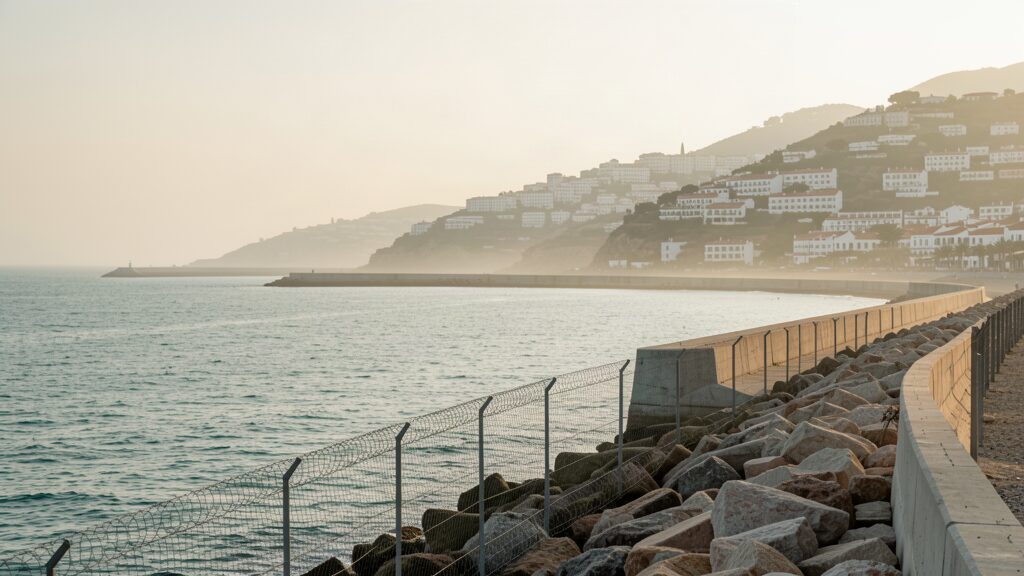
On the last two days of July 2026, sixty thousand people crossed from Morocco into Ceuta, a Spanish city of eighty-five thousand on the North African coast. Sixty-seven of them died: some drowned, some were crushed in a stampede on a breakwater. About forty-eight thousand of the sixty thousand went home within a day.
It was the biggest breach of the European Union’s only land border with Africa on record - six to seven times the size of the previous record, set in May 2021. The death toll alone, at least sixty-seven, exceeds the twenty-three killed in the 2022 Melilla fence crush, the previous mass-casualty event on that border.
Why did it happen? The answer tells you less about migrants than about who actually controls the borders of Europe. And it tells you something else: every politician with a role in this story has denied the cause-and-effect chain that produced it. Not one link of that chain is disputed. Every link is denied anyway.
The official explanations
Spain’s government offered an explanation: human-trafficking mafias, exploiting a Supreme Court ruling. The Spanish Refugee Aid Commission - the organization that runs migrant reception in Ceuta - says that explanation is “completely unfounded.” Its director general described the difference from the Atlantic route, where smugglers really do run boats: “These aren’t people who have to get into a small boat. This is a matter of being just meters from a land border, jumping into the sea and trying to get around a breakwater.”
The border between Morocco and Ceuta is not really a fence. It is a beach. You walk to the shore, jump in, swim around a breakwater, climb out on the Spanish side. No boats, no payment, no organization required. The only thing that stops it is the Moroccan security forces on the beach. When they act, it stops. When they “sit on their hands,” as analysts described them doing on 30 July, it does not.
This is not a theory. In May 2021, Morocco loosened its border controls after Spain allowed the leader of the Polisario Front (a resistance movement in Morocco) to be treated in a Spanish hospital, and roughly eight thousand people entered Ceuta in two days. Wikipedia’s careful phrasing is that Morocco “has periodically exerted political pressure on Spain by temporarily increasing the border’s permeability.” That is the diplomatic way of saying the gate has a gatekeeper, and that gatekeeper decides when it is open.
No one has produced a signed Moroccan order for the 2026 crossing. Intent is inference. But the behavior is documented, and the behavior has a pattern.
Four links in a chain
The 2026 crossing had a trigger sequence, and it is the least reported part of the story. Four events in four months, each with a cause and an effect. Each denied, at the time, by someone in authority.
April: the regularization. Prime Minister Pedro Sánchez announced mass regularization of undocumented migrants. 1.2 million people applied for citizenship. Whatever the moral case, the signal was mechanical: the Spanish state rewards presence. Twenty-two of the EU’s twenty-seven heads of government wrote to Brussels calling the scheme a pull factor. Sánchez called the criticism fake news.
June: the court ruling. Spain’s Supreme Court ruled that summary returns - handing intercepted people straight back - apply only to people breaching the physical fences, not to people intercepted at sea. A ruling made in the name of human rights. Its effect was an arbitrage: the swim route became legally safer than the fence route. Spain’s own interior ministry confirmed that smuggling networks used the ruling to encourage sea crossings. The court did not intend that effect. Intention is not what governs cause and effect.
July 20: the visit. Sánchez flew to Algiers, the first visit by a Spanish prime minister in four years. Algeria and Morocco are regional rivals. Algeria backs the Polisario Front against Morocco’s control of Western Sahara, and Spain had tilted toward Morocco in 2022, freezing Algeria out. Algeria is also Spain’s leading natural gas supplier - around 29 percent of imports, delivered through the Medgaz pipeline, which the Algerian state majority-owns. The older Maghreb-Europe line, which crossed Moroccan territory, Algeria shut in 2021, cutting Morocco off from its transit fees and cheap Algerian gas. The border is the lever Morocco has left. Four years of snubs, then a prime ministerial visit to the rival. Ten days later, the gate opened.
July 30-31: the gate. The Moroccan security forces sat on their hands. Sixty thousand crossed. Sixty-seven died. Forty-eight thousand went home.
Each link has a cause and an effect. Each link was denied, at the moment it happened, by someone with an interest in denying it. The man who announced the regularization denied it attracted anyone. The court denied its ruling changed any behavior. The government denied the sequence was a sequence at all - it blamed mafias. And Morocco denied everything by doing nothing, which is the most complete denial available.
Who benefits? The stupid decision test
Run the test. Who benefits from sixty thousand people crossing in two days?
Morocco benefits. It demonstrated, at the cost of a few hundred meters of beach, that it holds the tap on the EU’s only land border with Africa. Western Sahara recognition, EU funding, trade terms, fishing rights: the leverage is now on public display, and the demonstration was cheap. The relationship between Spain and Morocco is not diplomacy. It is a rent payment with occasional renegotiation.
The trafficking networks benefit. The court ruling was a legal upgrade. A route with less legal risk commands a higher price.
Sánchez benefits. Regularization buys a constituency. Blaming mafias buys an excuse. An EU solidarity package buys time.
Brussels benefits. A meeting of interior ministers costs nothing and changes nothing.
Who paid? The sixty-seven dead. The migrants returned to Morocco. The residents of Ceuta - a city of eighty-five thousand that absorbed seventy percent of its own population overnight, with facilities for unaccompanied minors running at twenty-four times capacity. And every EU member state, which learned that its border is only as closed as a foreign government’s mood.
The dead are the transaction cost of a leverage economy. Nobody in the room was thinking about the gate they do not control. That is the same pattern that produces ten-billion-pound IT failures: decision-makers who do not understand the mechanism, bills paid by people who were not consulted. See the Why Things Break series.
The denial is the point
The striking thing about Ceuta is not the crossing. It is the universal denial of cause and effect.
The left denies that regularization attracts. The word “pull factor” is treated as an insult rather than a description.
The right denies that the border is managed by a third country at all. The language of invasion implies an enemy with no legitimate grievance and no leverage - which makes the invasion inexplicable, which is the point.
Madrid denies that its own decisions produced the sequence. It blames criminals, which is safe: it turns the government into a victim of organized crime rather than an author of policy.
Brussels denies the architecture. The EU rents its southern border from Morocco, from Libya, from Turkey, and calls the rent “cooperation.” Admitting it is rented would require pricing it. The commission president’s reply to Sánchez was a call for “solidarity and a united European response” - a reply to the accused, not to the twenty-two leaders who had written the letter.
Morocco denies everything, because admitting leverage would require stating its price.
None of these denials is a mistake. Each one protects the denier. Admit the pull factor and you admit your policy caused harm. Admit the rented gate and you admit your border is biddable. Denial is not ignorance. It is the incentive structure doing its job - the same lens as the Seven Questions framework: ask who wins, and the denials explain themselves.
Not just Spain
Ceuta is not a Spanish problem, and the lesson is not for Spain. Schengen means that border is everyone’s border. Italy - whose own irregular entries are twice Spain’s, by Frontex’s count - suspended its Schengen arrangements with Spain for a month. That is theater, but it is revealing theater: a member state declaring the free-movement zone broken because of a beach in North Africa.
The lesson of Ceuta is that the ease of entry into the European Union is not fixed by geography or law. It is a policy variable, set by a handful of governments - some inside the EU, most of them not - in response to incentives that have nothing to do with migrants. The border did not get weaker. The system just got clearer about who controls it.
Next time a European politician tells you the border is secure, ask them to name the gatekeeper. They will say a fence, a coast guard, a computer system. It is none of those. It is a government in Rabat, holding the beach, and a government in Algiers, holding the pipeline. Spain pays rent to both, and the two landlords are enemies. The only question is who pays the rent, and how much is it? The sixty-seven dead were this year’s installment. The next one is already being priced.