


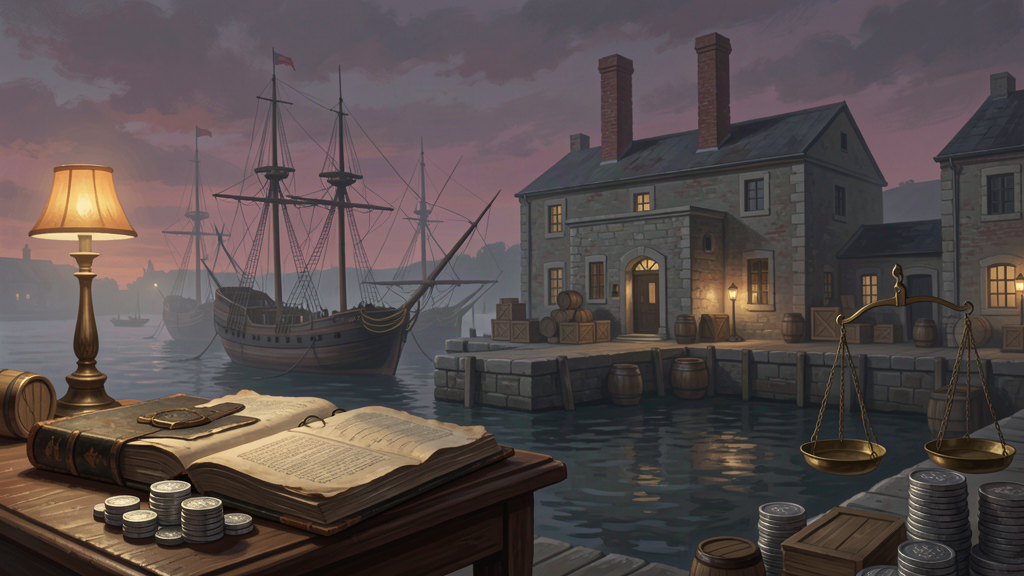
A nation is rich in proportion to the gold and silver it holds. Trade is how you get them, so a country should sell as much as it can and buy as little as it can, and a trade deficit is a loss the way an unpaid debt is a loss. The world’s stock of metal is fixed, so one nation’s gain is another nation’s loss - every coin you win is a coin someone else has lost.
That is mercantilism in three sentences, and it held most of Europe for roughly three hundred years. It is worth saying at the start that it is not a stupid idea. It is a coherent idea, built on a mistake about what wealth is - and the mistake is still with us, and shows up everywhere today.
Mercantilism is the last of the imposed alternatives in this act, and the only one that was never defeated. Feudalism fixed your place at birth. Socialism moved the price list into a committee room. Communism moved it into a plan. Fascism moved it into the party office. Mercantilism came before all of them, ran from the age of exploration, to the American Revolution, and then did what none of the others managed: it lost its argument and kept its influence. Rename the bullion as “the trade balance,” send the galleons home, and you have the protectionist case exactly as it is argued today.
The Word Came Late, Again
The practice ran for centuries before it had a name. The statesmen who worked it - Tudor treasurers, Habsburg viceroys, Colbert in France - thought they were applying ordinary good sense, not an ideology. Nobody called himself a mercantilist.
Adam Smith gave the thing its name, in 1776, and gave it as an accusation: the “mercantile system,” the phrase he uses through Book IV of The Wealth of Nations. The noun “mercantilism” is a nineteenth-century coinage, and the work that fixed its meaning is Eli Heckscher’s study of the same name, published in Swedish in 1931.
Heckscher’s reading is worth understanding, because it corrects the story each side prefers to tell. He argued that the point of these policies was the power of the state, not the enrichment of its people. The treasure was for armies and navies. The trade was for the flag.
Which is the first thing to notice. This was imposed, the way every system in this series was imposed. It needed an apparatus.
The Idea
Start with the case for it, because on the surface it was strong.
If you sell cloth abroad and take silver in return, you end the year with silver you did not have. If you buy wine abroad and pay silver, you end with less. Anyone can check that arithmetic at the counting house. And in an age when wars were fought with hired soldiers and bought ships, the argument had teeth: a king with a full treasury can raise an army; a king with warehouses full of unsold cloth cannot. The treasure was not a decoration. It was the ability to fight.
So the aim became a favorable balance of trade: export more value than you import, and collect the difference in metal. Everything else followed from that aim. Imports were a drain. Exports were a gain. A trading partner’s prosperity was your misfortune, and a colony’s purpose was to be a customer.
This contains two errors, and they need separating.
Where It Goes Wrong
The first error is about what wealth is. Gold and silver are not wealth. They are the claim on wealth - the voucher, not the meal. A country that hoards metal and makes nothing to buy with it has collected the vouchers and skipped the dinner. Smith made the point in the sentence the whole book leans on:
Quote
“Consumption is the sole end and purpose of all production; and the interest of the producer ought to be attended to only so far as it may be necessary for promoting that of the consumer. … But in the mercantile system the interest of the consumer is almost constantly sacrificed to that of the producer.”
- Adam Smith, The Wealth of Nations (1776)
The second error is that the pie is not of a fixed size. Nothing caps the amount of wealth two countries can create between them. If England makes cheap cloth and Portugal makes cheap wine, and each does what it does best, both end with more goods than they started with. The metal is just how they settle up afterwards. That is comparative advantage, and it is the reason trade makes both sides richer rather than one richer and one poorer.
The Apparatus
Here is the machinery, and there was a lot of it:
- Tariffs on imports. The foreign good is made dearer at the border, so the home producer can charge more than he otherwise could.
- Bounties on exports. A subsidy paid to the exporter, funded by the taxpayer, raising the price the home consumer pays for the same good.
- Monopoly charters. The East India Company, as one example, chartered in 1600, was granted a legal monopoly on English trade with the East. No competitor could enter. In exchange the crown got a share of the trade and a fleet it could appropriate.
- The Navigation Acts. From the great Act of 1651, and tightened through 1660, 1663, 1673 and 1696, goods bound for England had to travel in English ships, and the colonies’ most valuable products could be shipped only to England or another English colony.
- This is the forerunner of the Jones Act.
- The colonies themselves. A colony under this system is not a trading partner. It is a captive market: it sells its raw material to the metropole (the home empire) and buys the metropole’s manufactures, and the arrangement is enforced by the navy.
France under Jean-Baptiste Colbert, Louis XIV’s finance minister from 1661 until his death in 1683, is the purest case of the directing impulse. He founded state industries, set quality by decree, subsidized manufactures, and forbade the export of both bullion and skilled workers. Smith noticed that last detail and recorded it with distaste - the statutes that stopped artisans from leaving the country, on pain of forfeiting their land and being declared “an alien in every respect.” A system that has to jail its own weavers to keep them from leaving is telling you something about the deal it is offering.
The Treasure That Did Not Stay
Take Spain, the country that had the most of the thing everyone wanted.
The Spanish crown drew silver from Potosi and Mexico, and the Casa de Contratacion at Seville registered the American bullion from 1503. Earl Hamilton’s 1934 study, American Treasure and the Price Revolution in Spain, 1501-1650, compiled the bullion records and the Spanish price series across 150 years and found the two rising together. Later scholars, using better price indexes - Phelps Brown and Hopkins for England, Van der Wee for Brabant - found something that cut against Hamilton’s ranking: those countries’ prices actually rose more than Spain’s over the same period. So the point is not that Spain was uniquely punished. The point is narrower and worse for the doctrine. Spain passed laws forbidding the export of bullion, and the bullion left anyway, because it flowed out to pay for the goods Spain had declined to make. To forbid silver to leave by decree is to forbid water to run downhill.
There is a second, subtler thing happening in that flow, and this series has already met it. New money does not arrive evenly. The metal reached the crown, the contractors, and the merchants who handled it first, and their hands spent it while prices were still low. By the time it reached the wage-earner in the countryside, prices had already moved. That is the Cantillon effect, and it was named for a man writing in the 1730s who was describing exactly this world - the silver fleets, the rising prices, and the lag between the two.
Who Paid
Four groups, in order of visibility.
The consumer paid first, and paid twice. The tariff raised the price of the import he wanted. The bounty raised the price he paid for the domestic good, because the tax that funded the bounty came out of his pocket and the subsidy let the home producer charge more. Smith is uncompromising about the accounting: “the home-consumer is obliged to pay, first, the tax which is necessary for paying the bounty, and secondly, the still greater tax which necessarily arises from the enhancement of the price of the commodity in the home market.”
The colonist paid next. Made to sell cheap to the metropole and buy dear from it, he was, in Smith’s image, part of “a nation of customers.”
The taxpayer paid for the navy, the customs service, and the wars. Smith’s arithmetic is the passage worth remembering: the cost of maintaining and defending the empire - “more than two hundred millions have been spent, and a new debt of more than a hundred and seventy millions” in the two recent wars - exceeded the whole extraordinary profit the colonial monopoly could have earned, and exceeded the entire value of the trade it was protecting.
And who collected? The chartered merchants and the domestic manufacturers. Smith names them without hedging: “It cannot be very difficult to determine who have been the contrivers of this whole mercantile system; not the consumers, we may believe, whose interest has been entirely neglected; but the producers, whose interest has been so carefully attended to; and among this latter class our merchants and manufacturers have been by far the principal architects.”
That is not a conspiracy. It is a coalition - a small, organized, well-funded group with everything to gain from a tariff, against a large, diffuse group each of whom loses a little. Public choice theory explains the rest: the concentrated interest buys the policy, and the dispersed interest never notices the bill. It is the same asymmetry the regulation tax documents today.
What Broke It
The argument was one book, and the book has a date: 1776. The politics took another seventy years.
In Britain the fight was the Corn Laws, the duties on imported grain that kept food dear in order to keep rents high. Richard Cobden’s Anti-Corn Law League built the case in the 1840s; Sir Robert Peel carried the repeal in 1846, at the cost of his party’s leadership. The Navigation Acts followed in 1849. The estimate most often cited now is from Douglas Irwin and Maksym Chepeliev, writing through CEPR in 2020, who model the repeal as the elimination of a 28 percent tariff on imported grain and find grain imports rising nearly 70 percent, landowners losing about 3 percent of their income, and workers and owners of capital each gaining about 1 percent. A policy sold as protecting the nation turned out to be moving income from the many to the few.
And then the outcome that settles the argument. Britain - the most thoroughly mercantilist of the European powers - dismantled the system and became the workshop of the world. The country that had spent three centuries protecting its trade went on to dominate the trade of the nineteenth century precisely by opening it.
Not everywhere, and not all at once. The American colonies had been the system’s most valuable asset, and the enforcement tightening of the 1760s turned the theory into a grievance that ended in a war. The lesson runs both ways: a system that has to be enforced by soldiers eventually needs more soldiers.
The System That Was Renamed
Mercantilism lost its argument and kept its influence. Delete the bullion, delete the claim that a nation’s wealth is its stock of metal, and the shape that remains is familiar: exports are good, imports are a cost, a deficit is a defeat, and trade is a contest rather than an exchange.
You can hear it in every “we should make it here,” every “they are taking advantage of us,” every headline that reads a trade gap as a losing score. The tariff series traces the modern versions: the same instinct, wearing new legal clothes every few months.
The counterargument deserves stating, and it is not the same thing as mercantilism. Protecting a genuinely strategic supply chain - a chip fab, a munitions plant, the medicine you cannot buy in a crisis - is a defensible act, and the people who argue for it are not always wrong. But notice what the defensible version asks: which good, at what cost, borne by whom, and does it switch off when the emergency does? Those are the questions this series asks of every system it examines. The modern tariff rarely answers them. It answers with the old arithmetic instead.
The Lens
So let us answer the question in the title. What is mercantilism?
It is the first imposed alternative, and the most durable, because it did not need a party or a plan - only a customs house and a navy. It treated trade as a war fought with invoices, and it measured a nation’s wealth by the metal it had accumulated rather than the goods its people could buy. It was imposed from above, paid for by the consumer, the colonist, and the taxpayer, and it profited the chartered few. And it failed on its own terms: the treasure flowed away, the protected industries stayed weak, and the country that abandoned the system grew richest.
Feudalism needed castles. Socialism needed walls. Communism needed a list. Fascism needed a party. Mercantilism needed a customs house, a charter, a fleet and often an army - and it is the one still standing, under a different name.
Next time you hear that a country is losing because it buys more than it sells, ask the older question: losing what, and to whom? A nation that gets the goods is not the loser in a trade. It is the customer - and being the customer is the whole point.
This is the eleventh article in the series, ‘The Natural Condition of Mankind.’ Start here: The Name Is the First Argument. Previous: What Is Fascism?. Also in the series: What Is Feudalism?, What Is Socialism?, What Is Communism?, Before Money: Where Exchange Comes From, The Invention of Money, Banking and Credit, Trade and the Merchants: The Road Nobody Built, and The Great Escape: How Nine in Ten Humans Left Extreme Poverty